
From still to film
Virtual is not generated in one prompt. It is a short assembled shot by shot. This page is the production method: what is already locked, what to generate next, and how a still becomes a clip, then a cut, then the film.
Lock the story, not the pixels
The spine is the shooting script. Everything until [END RECORDING] is not the present: it is Dex already on the sofa, inside Adam’s recorded memory. The short cuts at the exact instant Adam stops recording.
- Read the English script (or Italian) once as a producer, not as a fan.
- Do not invent a new twist, a third character, or a different device name. The product is VR Flashback.
- If a shot is missing from the board, add it on the storyboard first — never start a clip from a scene that has no still.
Lock Adam and Dex
The loop is readable only if the two men never swap clothes or faces. Attach the sheets as character reference in every generate.
- Open Adam & Dex.
- Adam: mustard ochre blazer, taupe open collar, cream pinstripe trousers, two-tone loafers, black smartwatch, light-brown side part, clean-shaven.
- While Adam is recording (Phase 2, shots 02, 02b, 04–08): the VR Flashback capture earpiece is in his right ear and must be readable in the still. It is the device. Not a visor on his head. Not AirPods. Shot 02 is departure — he walks to his coupe. Shot 02b is inside: case on the pale leather passenger seat, he looks at it. Shots 03–03b are the unboxing memory: ears empty until 03b panel 04, when he puts the earpiece on. Shot 05b is arrival at Dex’s, immediately before he knocks (06).
- Dex: charcoal crew-neck, mid-blue jeans, black socks indoors, dark curly hair, short beard. Dex wears the VR visor and headphones only for playback.
- Both men are very wealthy. Adam: stone-and-glass villa, dark luxury coupe. Dex: architect-designed house, high ceilings, designer sofa — t-shirt at home is ease, not a small flat. No tract housing, no cheap cars.
- Copy the lock paragraph into the prompt. Do not mix wardrobes. Do not invent a third look.
Lock the four visual phases
Color is story. A clip in the wrong grade reads as the wrong time.
- Phase 1 — HUD. Pitch black, cyan / white neon, no people. Shots 01.
- Phase 2 — Adam’s memory (false present). Teal shadows, slight desaturation, vignette, faint chromatic aberration. Shots 02–08.
- Phase 3 — Dex restore. Amber / black-and-white, motion blur, glitch, white hits. Shots 09–11.
- Phase 4 — real present. Warm daylight, sharp, no teal, no glitch. Shots 12–13.
Generate the storyboard stills
Thirteen numbered frames plus the 03b and 09b memory strips. One still = one future clip. Shots 05 (drive), 05b–06–10 (arrival bridge), and 07 (conversation) are expanded on the shooting board: 05.1–05.4, 05b.1 · 06.1 · 10.1, and 07.1–07.11. Replicate (Flux LoRA and Flux 2 Pro) is retired for stills — the quality did not hold. Generate only in Nano Banana / Gemini or ChatGPT Images: one thread, one plate attached (the file named under the shot), copy the prompt on the prompt board or under the keyframe.
- Pick a shot on the prompt board to replace, or send a tighter take of an existing still.
- Attach the one plate named under that shot. Paste the prompt under the still. Keep the phase language (teal / amber / warm) inside the prompt.
- Generate several. Keep the one that matches face, wardrobe, and grade — not the prettiest stray.
- Name the file
01.jpg…13.jpg(shot number only — or02b,03b,05b,09b, or07.1…07.11). - Send it to linkberri@gmail.com. We replace the still on the board when it locks.
Do not start video on a shot that is still a draft (wrong jacket, mixed wardrobe, missing earpiece while recording, wrong grade).
Build the diegetic screens
Some “shots” are software, not people. They already exist as pages and can be recorded or composited.
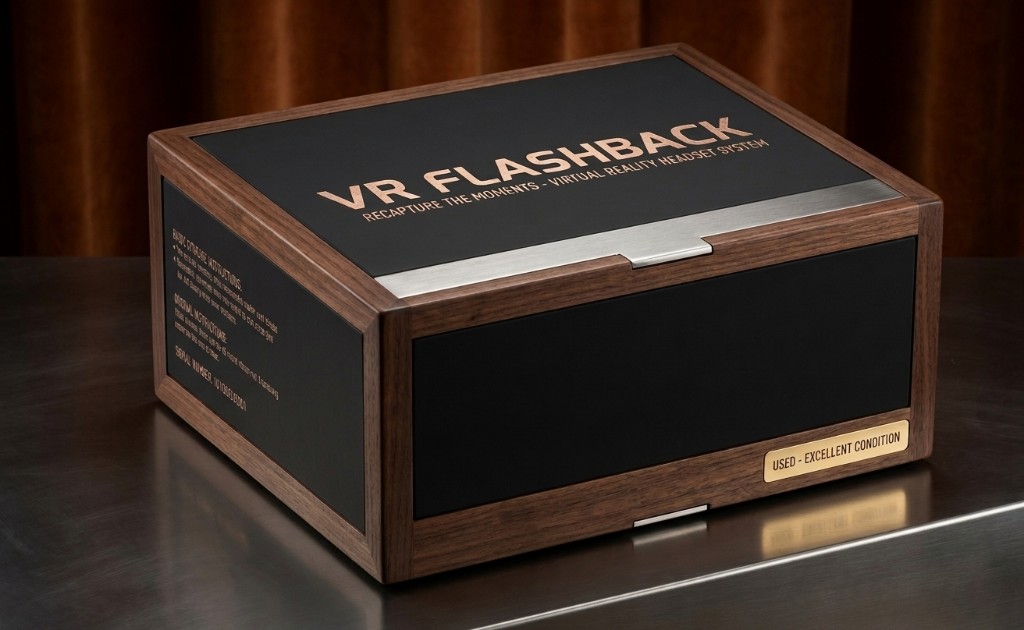
- Product surface: VR Flashback landing (keep it diegetic — no workshop language on that page). Locked hardware: capture earpiece and presentation case — not cardboard.
- In-film UI: [START RECORDING] (opens in a new tab) and restoring original memory (opens in a new tab).
- Capture those screens as clean HUD plates for shots 01, 04, 08, 09 — or regenerate them as stills with the Phase 1 prompt, then animate scanlines later.

Turn each still into a clip
Image-to-video (Kling, Runway, Luma, or whatever is current). One locked still → one clip. Do not morph Adam into Dex.
- Use the locked still as the first frame (and last frame if the tool allows).
- Motion brief, in the prompt: camera (static / slow push / POV drive), who moves, what must not change (face, jacket, room).
- Keep clips short: about 3–8 seconds. This film is cuts, not a single take.
- Reject any clip that drifts wardrobe, adds a third person, or slips into the wrong grade.
- Store files as
02.mp4matching the shot number. Same folder logic as the stills.
Shot 02b is Adam seated, looking at the case on the pale leather passenger seat — before the purchase memory. 03 is Adam looking at the Series 01 landing (no case, ears empty). 03b is the four-panel strip (package, open case, instructions, earpiece on). Shot 05 is after that memory: POV from the same coupe, driving, music loud, case still on the seat. Not an economy interior.
Sound before picture lock
Sound carries the loop. Picture without the wake-up track will not read.
- Phase 1: low binaural bed, UI ticks, synthetic VO or on-screen text only.
- Phase 2: car radio / music-video energy, then drop for the unboxing memory, then full volume again on the drive.
- Phase 3–4: the wake-up track Dex chose starts the instant Adam hits END. Micro-flashes sit on that music. Real present: room tone, no score, Adam’s line.
- Record or generate: “How did it go?” / «Com’è andata?» — one take, dry, close. No Dex reply.
Edit like a memory, not a trailer
- Timeline in shot order 01 → 13. Do not reshuffle the twist.
- 01 dissolves into 02. 08 is a hard cut + glitch; music of 09 starts on the cut, not before.
- 09–11 are flashes: a few frames each, overlapping, then 12 holds.
- Leave HUD plates readable. Do not cover START / END with titles.
- Grade only to match the four phases already in the generates — do not “fix” teal into orange in phase 2.
Picture lock, credits, release
- Watch once without sound, once with. If a face or jacket pops, that shot goes back to step 04.
- Titles: Virtual · #VirtualShortFilm. End card: the collective, then names of who sent locked frames (shot numbers).
- Export a web master (H.264/H.265) and an archive. Publish the cut; keep this worksite open for replacements.
- Log the lock on the workshop log. Email is still the intake for new stills even after a first cut.
One-prompt the whole film. Mix Adam’s mustard with Dex’s tee. Put a visor on Adam while he records — the capture device is the earpiece. Drop them into a modest apartment or a cheap car. Put a donate button or “making of” on the VR Flashback landing. Start video on an unlocked still. Add shots after END that explain the trick.